Evidence from North America


On the Yucatan Peninsula, southern Mexico,
is the magnificent center of administration and military might
of the Mayan Empire, Chichen Itza.

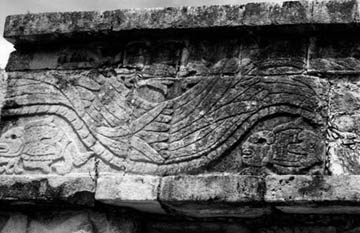
Here we find a platform on the central plaza,
where the dolphin is represented surrounding the feathered serpent, Quetzalcoatl.
This carved panel is on the "Venus Platform",
so-named because of its frequent references to the planet Venus,
which was very important in Mayan cosmology.

A close up view of one of the Mayan "Venus dolphins".

Kukulcan, a revered figure in Mayan history and mythology.
Here he is depicted emerging from the mouth of a serpent which has two legs.

This is thought represent a type of yoga, or transcendental practice
by which a human can re-orient himself to the heavens,
ascending from the terrestrial realm, where we need feet
(or slither on the ground), to a state in which we may rely on our "feathers",
or higher understanding.
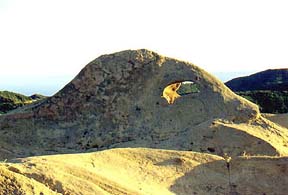
Above Malibu, on the California coast near Los Angeles, is this ceremonial site,
where a natural rock formation embodies the deep reverence
held by the local indigenous people, the Chumash indians, for the Dolphin.

According to the Chumash origin myths, Hutash, the Goddess of the heavens,
helped them to leave a former island home, where disastrous practices,
using crystals, threatened them with total annihilation.
She did this by building a rainbow bridge to the mainland.
When some of the people looked down in fear as they crossed,
Hutash took them into the sea and transformed them into dolphins.

Sunset over Point Dume,
where the Chumash indians have conducted dolphin ceremonies for centuries.

Adelina, a Chumash elder,
sings for her long lost relatives who became dolphins.

This Chumash design depicts the transformation into,
and similarity of humans and dolphins.

Kote Lotah, and A'lukoy, Blue Dolphin Woman, of the Chumash indians,
living in Los Angeles. Grandparents and active medicine people,
the dolphin connection is still very much alive for the Chumash indians,
by their efforts.

In 2001, when a developer began clearing land in downtown Miami, just at the mouth of the Miami River,
a sharp-eyed workman spotted a circular foundation.
Upon investigation, it was discovered that this had been a ceremonial site
for a long-vanished tribal culture, the Tequesta.
Inside the circle was found the ceremonially buried skull of a dolphin,
among other sea creatures.

The Miami Circle, as it is now called,
was saved from development and a park is now being built
to share this important find with the world.

Among the native people of the northwest in America,
there are different views of cetaceans.
In some traditions, the whale is seen as a negative spirit.

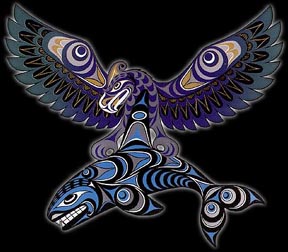
Here, the Great Eagle is taking a whale.
As the story goes, the whale struggled and was dropped,
where he made the hills and valleys of the region.

An Orca, depicted by a Haida Indian, hunters of the whale.

A Kwakiutl ceremonial Orca "clapper" used in dances.

In the European imagination, Native Americans had conquered the natural world,
becoming peaceful by having slayed the ancient demons.

In the epic poem "Hiawatha", this indian hero is shown slaying the ancient "serpent",
the source of the non-rational, the oceanic mystery that held scientific progress back.


ARCHIVES


MAIN