Christianity and the Cetaceans


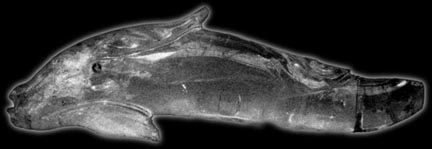
A crystal dolphin, found at the bottom of a well
in Carthage, Tunisia, ca. 300 AD, before the change
of Christ's symbol from Dolphin to Cross.

The photograph from which the drawing in Souls in the Sea was made.
This carving was made just after the Nicean Council meeting,
when the message of Jesus was transformed.

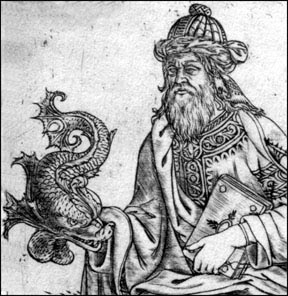
John the Baptist.
The name John is derived from the same root as the name Oannes.
In several languages, the name is spelled Ioanne, or Johanne.
He is a watery mystery, half man and half water master.

In early Christian mythology (stories of the Saints),
Jasconius the Whale an the enormous whale who provided safe shelter
for a wandering group of monks who were searching for the Isles of the Blessed.
Each Easter they would find themselves blown by the winds, back to the same island,
where they celebrated Easter Mass. After seven years of this cycle,
they discovered that the island was actually the back of Jasconius.

This mysterious image may be of Jesus on the back of a dolphin.

In many cultures, in dozens of art styles,
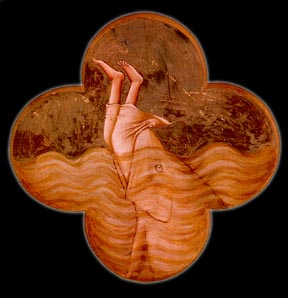
the story of Jonah and the Whale has been told.
Swallowed by a whale, he had refused to preach to the city of Nineveh,
which was the center of the worship of Dagon, the half-fish, half-man God
of whom Jehovah, the Hebrew God, was jealous.
Once the whale regurgitated him onto the land, Johan was much chastened,
and fulfilled his duty, preaching to the city.
It was said that his message was recieved well,
and Nineveh gave up their former worship.
No doubt, the whale story had had a powerful effect on them.

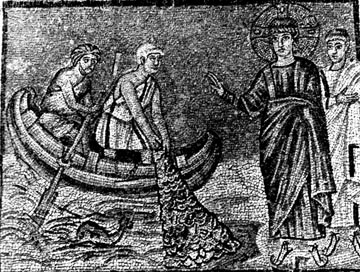
When Jesus demonstrates his mastery by helping Simon (Peter), James, and John
to catch so many fish that their nets begin to break,
these three disciples decide to follow Him. (Luke 5:1-11)

In this image we see Jesus and a dolphin helping the fishermen.
It is clear that the fish and the dolphin are recognized as different,
and that the dolphin has some beneficial relationship to the story.
Perhaps this is a biblical tale of cooperative fishing,
as has been part of many coastal cultures, around the world,
as much as it is a tale of Jesus's abilities.

Here, two apostles are depicted with dolphins supporting them.
This image is a mosaic in Ravenna, Italy, from 525 AD.
The image of the dolphin persisted in some places...

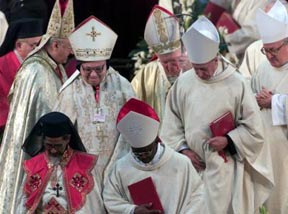
The ceremonial hat of the Pope is a stylized version
of the much earlier Fish Head priest's headgear.
This hat may only be worn by those who have been indoctrinated
into the secret teachings of the Roman Catholic church,
which confers the title of Bishop.

A group of bishops, with their ceremonial "dolphin hats".

A contemporary tourist item of questionable solemnity (it is a bottle opener),
this depicts in surprising detail the face of the current pope,
including his name,"Joannes Paulus."
Curiously, the name Joannes is not latin, but is much older,
and is the name Oannes with an added, silent "J".

In addition, "Pont Max" refers to his title as Pontifex Maximus,
which has been a title reserved for the high priest
of these who worship Vesta, the goddess of fire.
The "Vestal Virgins" are said to have held and protected
the sacred dolphin-bone "gods of Troy",
which were the basis for founding Rome.

The pool that still exists as part of the Temple of Vesta, in Rome,
where the Vestal VIrgins protected the dolphin-bone "gods of Troy."

Why a large, swimmable pool, in a temple of fire worship?
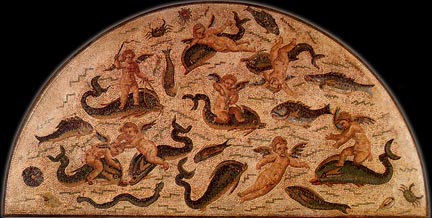
Heavenly delight, as angels and dolphins play together.

Another version of the author's re-joining of the Christ and Dolphin images.


ARCHIVES


MAIN