
Whale Anatomy: A few details

Cetaceans without teeth, who filter sea water to extract food,
are the "Mysticetes".
Their skeletons are odd, with huge heads.

This Humpback Whale can hold 15,000 liters of water in its mouth,
straining its tiny food from the water.

The Baleen, which used to be called "whalebone",
was used for thousands of human articles,
from typewriter springs to buggy whips.
In today's petroleum-based world,
the baleen was replaced by the invention of plastics.

A Sperm Whale, which is an "odontocete", or toothed whale,
has an unusually large skull, with an odd breathing apparatus.
The Sperm Whale has the largest brain ever produced on Earth.
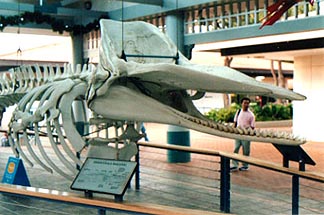
Curiously, this photo from the front of the Whaling Museum in Maui,
has a Japanese tourist between the teeth of the Sperm Whale.
The Japanese recently began killing Sperm Whales again.
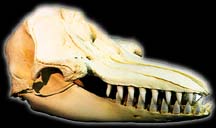
The skull of a Pygmy Killer Whale, one of the cetacean-eating species,
generally called "blackfish"
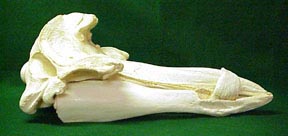
A Hubb's Beaked Whale skull.
Note the odd, strap-like teeth, curving over the upper jaw.

The Beluga Whale has the widest range of sounds of any cetacean.
Inside the blowhole is a structure not unlike several balloons,
which can be squeezed and controlled to force air between them
, producing an infinite range of sounds.

The melon of the Beluga is filled with a rare oil that serves as an acoustic lens,
shaping the sounds it makes.


